
If your journal’s guidelines say ‘LaTeX preferred,’ you’re probably here for one of two reasons: you need to know which publishers actually require LaTeX for professional publications, or you need to decide whether to learn it or outsource the formatting. This guide answers both.
After formatting hundreds of papers across every major academic publisher, we’ve noticed something most “why use LaTeX” articles miss: whether LaTeX matters for your publication depends almost entirely on your field and your target journal. A physicist submitting to Physical Review Letters and an education researcher submitting to a Wiley journal face completely different realities.
Below is a publisher-by-publisher breakdown, an honest Word comparison, and a straightforward decision framework. No listicle padding – just the information you need to make the right call.
⚡ Short on time?
If you already know you need LaTeX formatting, we deliver journal-compliant .tex files in 72 hours. From $49. Guaranteed to compile.
Which Journals and Publishers Require LaTeX
This is the most actionable section. If your target journal is below, the “should I use LaTeX?” question is already answered.

Publisher LaTeX Requirements – Quick Reference
| Publisher | LaTeX Class | Requirement | Key Journals | We Support? |
|---|---|---|---|---|
| IEEE | IEEEtran | Required | All Transactions | ✓ Yes |
| ACM | acmart | Required | SIGCONF, TOG | ✓ Yes |
| APS | REVTeX | Required | Phys Rev A–E | ✓ Yes |
| AIP | AIP templates | Strongly preferred | J. Chem. Phys. | ✓ Yes |
| Elsevier | elsarticle | Preferred (STEM) | 2,500+ journals | ✓ Yes |
| Springer | svjour3 / llncs | Preferred (STEM) | LNCS, math/phys | ✓ Yes |
| MDPI | MDPI templates | Supported | All OA journals | ✓ Yes |
| PLOS | PLOS template | Supported | PLOS ONE | ✓ Yes |
| Wiley/T&F/CUP | Varies | Accepted | Various | ✓ Yes |
| arXiv | Any | De facto standard | All preprints | ✓ Yes |
The pattern: equation-heavy fields overwhelmingly use LaTeX (physics, math, CS). Engineering and economics are majority LaTeX. Biology, medicine, social sciences are mixed.
For IEEE specifically, see our step-by-step IEEE LaTeX template formatting guide.
What LaTeX Does That Word Can’t for Professional Publications
We’ve converted papers from Word to LaTeX for every publisher in the table above. These are the things that make LaTeX for professional publications genuinely worth the effort – not theoretical advantages, but differences we see cause real problems in real submissions.
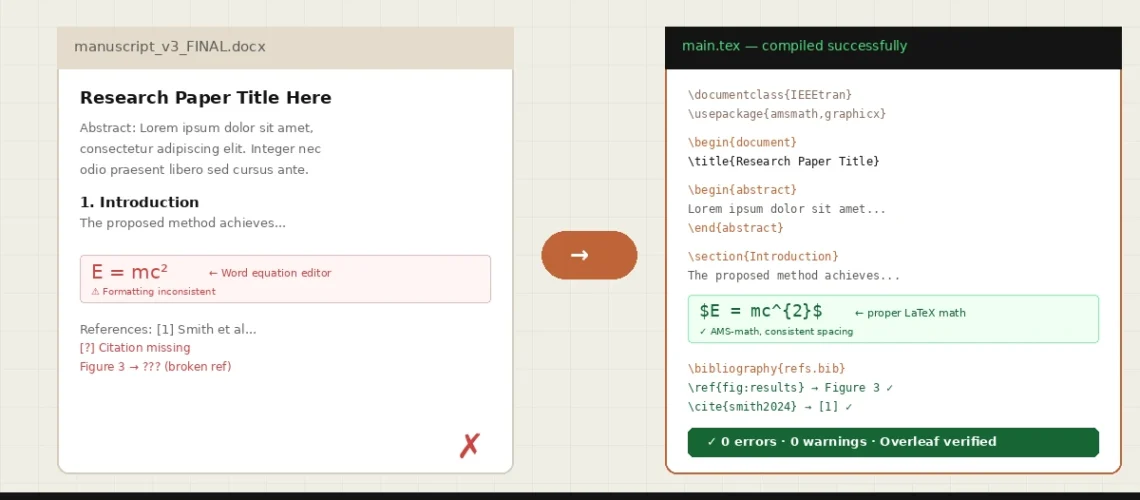
Equations: The non-negotiable difference. LaTeX’s AMS-math renders equations with consistent spacing and sizing that Word’s editor doesn’t match. Experienced reviewers spot “Word equations” immediately. In our experience, this is the single biggest quality signal in a STEM submission.
Template compliance: LaTeX templates are deterministic – if it compiles, the formatting is correct. We’ve seen papers desk-rejected because the author unknowingly changed a margin by dragging a ruler in Word. That can’t happen in LaTeX.
References: \label{}/\ref{} and BibTeX mean every figure number, equation reference, and citation updates automatically. Switching journals = changing one line.
Long documents: A 250-page thesis compiles as reliably as a 10-page paper. No formatting corruption, no figures jumping pages.
When Word Is Fine and When LaTeX Is Worth It
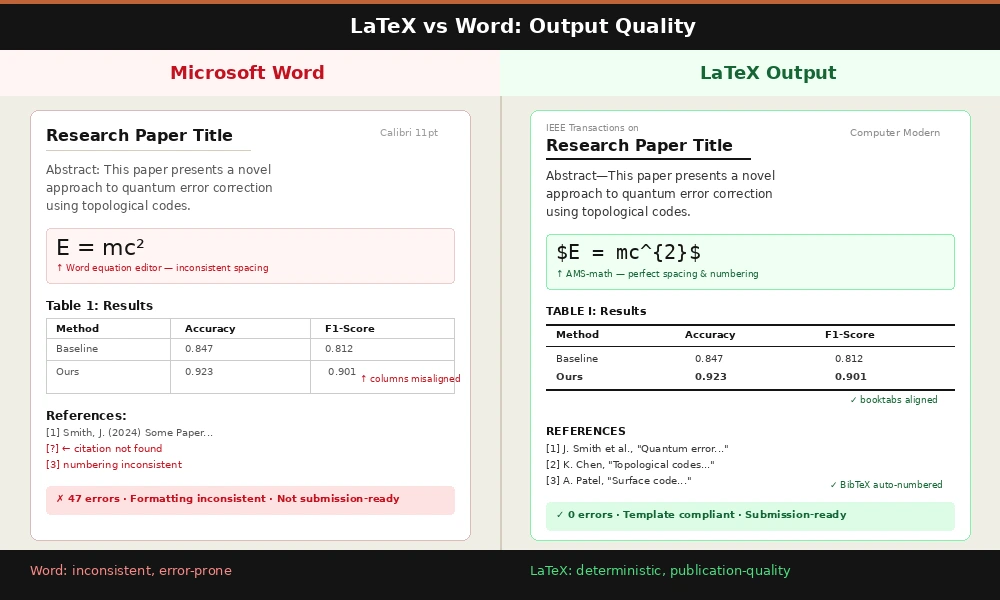
An empirical study by Knauff & Nejasmic (2014) found Word users were faster on text-only documents; LaTeX users performed better on mathematical content. Use the right tool for the task.
LaTeX wins on: equations, long documents, template compliance, bibliography management, version control.
Word wins on: learning curve, text-heavy papers without math, real-time collaboration, quick edits.
Which Publications Benefit Most
STEM journal articles – Equations, theorems, publisher templates. LaTeX’s home turf.
Theses – 100–300+ pages with strict institutional formatting. Word users regularly spend their final week fighting formatting.
Conference papers – Strict page limits. If it compiles, it meets the spec. Critical for NeurIPS, ICML, CVPR.
Books – Indices, cross-references across 200–500+ pages. Springer, Cambridge, MIT Press prefer LaTeX.
Overkill for: short reports, grant applications, internal documents, fields with no LaTeX tradition.
📦 Submitting to one of these publishers?
We format to IEEE, Elsevier, Springer, ACM, and 200+ other journal templates. Compiled .tex + PDF in 72 hours.
From $49. Free revisions after peer review.
Should You Learn LaTeX or Have Someone Format Your Paper?
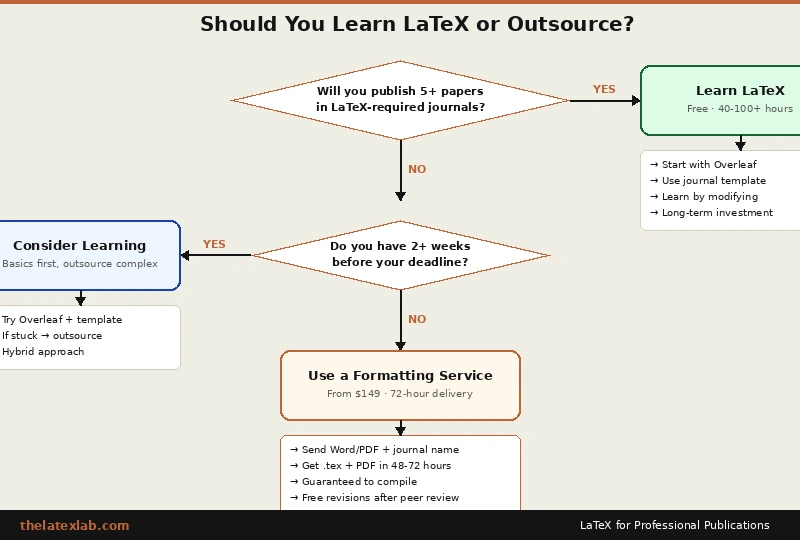
Learn if: your field uses LaTeX routinely, you’re early-career with many papers ahead, you have time. Start with Overleaf. Don’t learn “LaTeX in general” – pick your journal’s template and modify a sample paper. If you hit errors, our guide to common LaTeX compilation errors has copy-paste fixes.
Outsource if: deadline is 1–2 weeks away, it’s a one-time conversion from Word, or your field won’t use LaTeX regularly. Budget: $49–$449 for papers, $599–$1,999 for theses. For the full process, see our Word to LaTeX guide.
Hybrid: Outsource your first paper, study the .tex files, handle simple formatting yourself over time. Make sure you receive .tex source files, not just a PDF.
At TheLatexLab, you send your manuscript in any format, tell us the target journal, and get compiled .tex + PDF within 48–72 hours. 200+ templates, free post-review revisions, and every file tested in Overleaf before delivery.