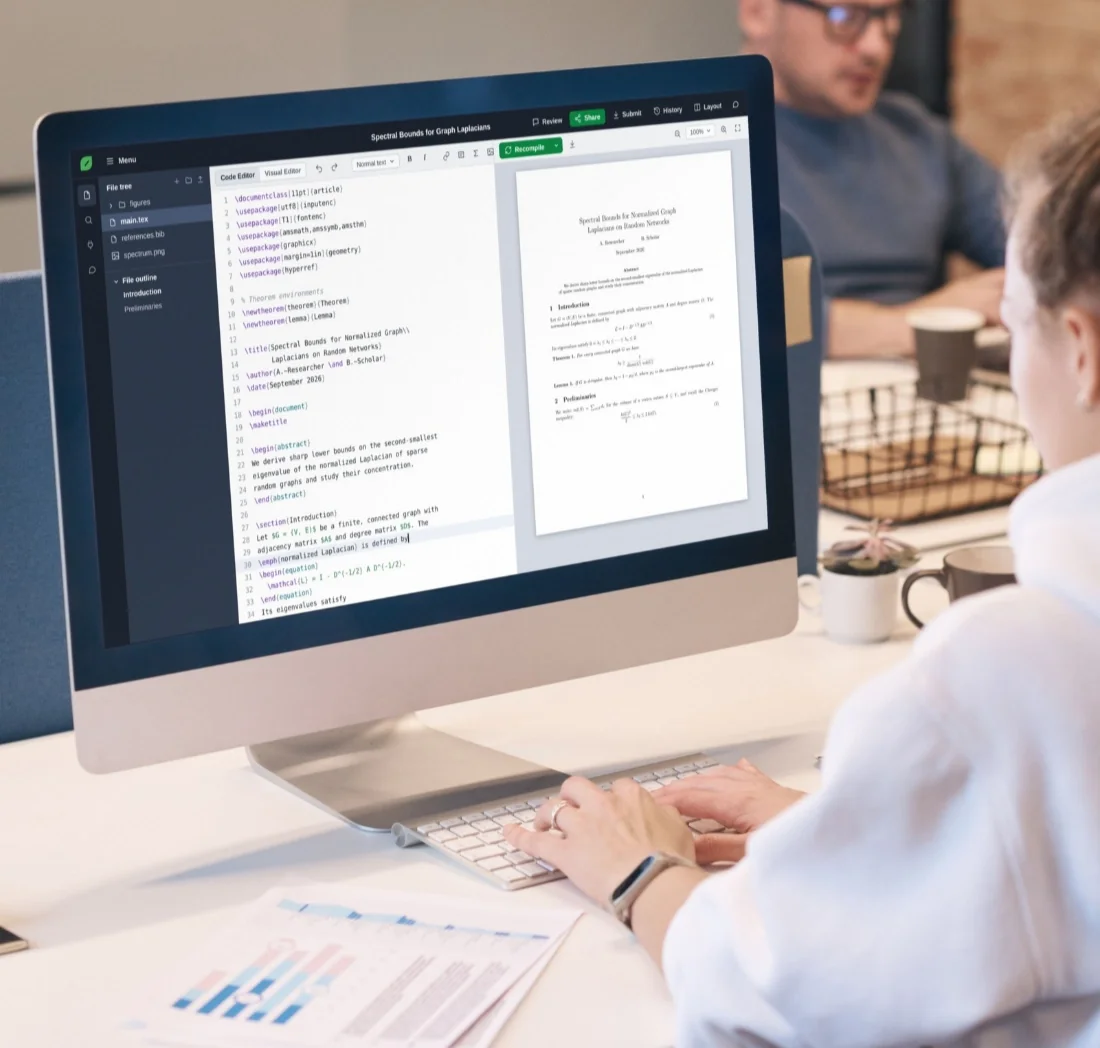


Dissertation LaTeX Formatting for German Universities. Promotionsordnung-Compliant. KOMA-Script Native.
German universities don’t work like American or British ones when it comes to dissertation formatting. The rules aren’t set at the university level — they’re set at the faculty level, in the Promotionsordnung. Every faculty has its own requirements for front matter, declaration wording, and submission format. Miss any of them and the Dekanat sends your dissertation back.
We format dissertations in LaTeX for German universities. We build on KOMA-Script (the standard German LaTeX document classes), configure your faculty’s specific requirements, handle the Eidesstattliche Erklärung with the current prescribed wording, and deliver PDF/A output when required for electronic submission.
7–10 day standard delivery. Compiled in Overleaf. Promotionsordnung compliance verified.
We’ve formatted dissertations for researchers at these German universities
The issue we see most often with German dissertations isn’t a compilation error — it’s the Eidesstattliche Erklärung. Every German university requires a statutory declaration (sworn statement of independent authorship), and the exact wording is legally specific to each faculty. Using the wording from another faculty — even at the same university — can result in your dissertation being sent back. We verify the current prescribed text from your faculty’s Promotionsordnung before we format the declaration page.
What Makes German Dissertation Formatting Different
KOMA-Script, Not Standard LaTeX Classes
German academic LaTeX doesn’t use the standard article, report, or book classes. It uses KOMA-Script — specifically scrreprt or scrbook — which are purpose-built for German academic documents and provide correct A4 layout, European typographic conventions, and German-language integration out of the box.
Many German university LaTeX templates are built on KOMA-Script. TU Darmstadt has TUDa-Thesis (based on KOMA), University of Passau has se2thesis (based on KOMA), and the widely-used Stuttgart dissertation template uses KOMA with LuaLaTeX. If your university has an official template, we use it. If they don’t, we build on KOMA-Script directly — it’s what the German LaTeX ecosystem expects.
The Promotionsordnung Controls Everything
In Germany, dissertation formatting rules come from the Promotionsordnung — the doctoral regulations specific to your faculty. Not the university, the faculty. The Promotionsordnung at the Faculty of Computer Science at TU Munich has different formatting requirements than the Faculty of Mechanical Engineering at TU Munich. And these documents are updated periodically, so the rules your colleague followed two years ago may no longer apply.
We download and read your faculty’s current Promotionsordnung (and any supplementary guidelines from the Promotionsausschuss) before configuring your template. This includes checking for recent amendments — German universities occasionally update their Promotionsordnungen mid-year without a public announcement, and the updated version only appears on the faculty’s website.
Eidesstattliche Erklärung (Statutory Declaration)
Every German dissertation must include an Eidesstattliche Erklärung — a sworn statement that you wrote the dissertation independently, used only the stated sources, and haven’t submitted it to another institution. The exact wording is prescribed by your faculty and has legal significance — it’s not a template you can improvise.
Recent additions at many universities (Hamburg, Cologne, and others) now require you to declare whether generative AI tools were used in the preparation of the dissertation, and to confirm that you take full responsibility for all content regardless of any AI assistance. We track these additions and include the current wording for your specific faculty.
Zusammenfassung + Abstract (Dual Language)
Most German Promotionsordnungen require both a German Zusammenfassung and an English Abstract, regardless of which language the dissertation is written in. Some require the German version first; others require the English version first. Some have maximum word counts. We format both in the order your faculty prescribes.
Kumulative Dissertation (Publication-Based)
The kumulative Dissertation — where you submit a collection of published papers with a connecting “Manteltext” (wrapper text) instead of a traditional monograph — is standard in German natural sciences and medicine. The Promotionsordnung specifies how many papers are required, whether they need first-authorship, and what the Manteltext must contain.
Formatting a kumulative Dissertation in LaTeX has specific challenges: each paper was formatted for a different journal, each has its own reference style, and they need to be unified into a single document with a Gesamtliteraturverzeichnis (consolidated bibliography) or per-chapter bibliographies. We also format the Eigenanteilserklärung (declaration of individual contributions) that most faculties require for each included paper.
PDF/A for Electronic Submission
German universities are increasingly requiring PDF/A format for electronic dissertation submission. TU Darmstadt explicitly requires PDF/A-2b. The Deutsche Nationalbibliothek (DNB), which archives all German dissertations, requires PDF/A for long-term preservation. We configure LaTeX to produce PDF/A-compliant output with embedded fonts and correct metadata.
Veröffentlichungspflicht (Publication Obligation)
Unlike most countries, Germany requires that dissertations be published. The Kultusministerkonferenz mandates this, and your Promotionsordnung specifies the accepted forms: electronic publication through the university library, print publication with a minimum number of copies (typically 3–6), or publication through a Verlag. The Veröffentlichungsversion may differ from the submission version — it includes the Titelblatt with examination date, Gutachter names, and Prüfungskommission details. We prepare both versions when needed.
German Universities We’ve Formatted For
Germany has over 100 universities with doctoral programs. Formatting requirements vary not just between universities but between faculties within the same university. Here’s what we know about the major institutions.
TU Munich (TUM) & LMU Munich
Bavaria’s two major universities have extensive Promotionsordnungen. LMU’s medical faculty has detailed kumulative Dissertation requirements including Impact Factor thresholds for accepted journals. TUM’s engineering faculties are more flexible on format but strict on the Eidesstattliche Erklärung wording. Both universities accept electronic submission through their library systems.
TU Darmstadt
TU Darmstadt has one of the most well-maintained LaTeX template ecosystems in Germany (TUDa-CI templates) with built-in PDF/A support. Their electronic submission system validates PDF/A compliance automatically. We work with the TUDa templates regularly and know their specific configuration requirements.
Heidelberg, Göttingen, Freiburg
The traditional research universities in southern and central Germany. Formatting requirements are detailed in each faculty’s Promotionsordnung. Freiburg’s medical faculty has particularly specific rules for kumulative Dissertations. Göttingen requires electronic submission through their institutional repository (eDiss).
Humboldt Berlin, FU Berlin, TU Berlin
Berlin’s three major universities each have their own Promotionsordnungen across multiple faculties. FU Berlin’s political science faculty has detailed criteria for kumulative Dissertations including minimum publication requirements. Humboldt’s theology and philosophy faculties have specific formatting traditions. TU Berlin’s engineering departments accept various LaTeX templates.
RWTH Aachen, University of Stuttgart, KIT Karlsruhe
The major technical universities. Stuttgart has a well-known LaTeX dissertation template on GitHub using KOMA-Script with LuaLaTeX. RWTH Aachen and KIT both have faculty-specific formatting guides. Engineering dissertations at these institutions often include extensive TikZ/PGFplots figures that need careful float management.
Don’t see your university? We format for any German institution. Send us your Promotionsordnung or tell us your university and faculty, and we’ll find the current requirements.
What You Get
KOMA-Script Based Template
Your dissertation built on scrreprt or scrbook with KOMA-Script’s German typographic defaults. Correct paragraph spacing, heading styles, and page layout. If your university has an official LaTeX template (TUDa-Thesis, anuthesis, etc.), we use it. If not, we build a compliant template from KOMA-Script directly.
Front Matter to Promotionsordnung Specifications
Titelblatt with the prescribed wording for your faculty. Eidesstattliche Erklärung with the current required text. Eigenanteilserklärung for kumulative Dissertations. Zusammenfassung and Abstract in the correct order. All preliminary pages formatted to your faculty’s exact requirements.
German Language Support
Proper German hyphenation via babel (ngerman). Correct handling of umlauts, eszett, and special characters. German-language captions and headings where required (Abbildung, Tabelle, Kapitel, Literaturverzeichnis). For dissertations written in English, we configure the correct bilingual babel setup.
Bibliography in Your Required Style
German academia uses varied citation styles: alphabetic labels ([Jon95]) common in computer science and engineering, numeric in natural sciences, author-date in social sciences. We configure biblatex with the correct style for your field and faculty requirements.
PDF/A Output When Required
If your university requires PDF/A for electronic submission, we configure the LaTeX source to produce compliant output with embedded fonts, correct metadata, and validated format. Tested against PDF/A validators before delivery.
Complete Deliverable
Clean .tex source files (KOMA-Script), .bib bibliography file, all figure files, compiled PDF (standard and/or PDF/A), README with compilation instructions and Overleaf setup guide. 2 revision rounds included.
Who This Is For
How It Works
Upload Your Dissertation & Tell Us Your University and Faculty
Send your dissertation in any format (Word, PDF, or existing LaTeX). Tell us your university, faculty, and degree type (Dr. rer. nat., Dr. phil., Dr.-Ing., Dr. med., PhD, etc.). If you have your Promotionsordnung or a link to the current version, include it. If not, we’ll find it.
Get a Fixed Quote in 2 Hours
We assess your dissertation length, chapter count, equation density, bibliography size, and whether it’s a monograph or kumulative Dissertation. Exact price within 2 hours. No hourly billing.
We Format, Compile & Verify
KOMA-Script template configured. Front matter set to your Promotionsordnung. Eidesstattliche Erklärung with your faculty’s exact wording. Bibliography compiled. German hyphenation verified. PDF/A output generated if required. Compiled and tested in Overleaf.
Download, Review & Submit
You receive the complete .tex source, compiled PDF, and all supporting files. Two revision rounds included. If the Dekanat requests changes, we fix them.
After Submission: Disputation & Veröffentlichung
After your dissertation is submitted, it goes to the Gutachter (reviewers). After the Disputation (oral defense), you may need to prepare the Veröffentlichungsversion — the publication version that includes the examination date, Gutachter names, and any post-defense corrections required by the Prüfungskommission. We prepare the Veröffentlichungsversion as an add-on, using the same .tex source updated with the publication-specific front matter.
German Dissertation Formatting Pricing
Fixed prices in USD. No hourly billing. You know the cost before we start.
- Pagesup to 350
- Chaptersup to 15
- Revisions2 rounds
- PapersCustom
- ManteltextIncluded
- Revisions2 rounds
Why Researchers at German Universities Choose Us
Most LaTeX formatting services are based in the US or UK and build on standard LaTeX classes. They don’t know KOMA-Script, they don’t read Promotionsordnungen, and they don’t understand the difference between an Eidesstattliche Erklärung and a standard declaration page. Local German editing services (Lektorat) know the academic system but typically don’t work in LaTeX.
We sit in the gap between the two. We don’t touch your research content. We format the document in LaTeX using KOMA-Script, apply your faculty’s Promotionsordnung requirements, handle the German-specific elements, and deliver clean .tex source files that compile correctly and pass the Dekanat’s format review.
★★★★★
“My faculty's Promotionsordnung had been updated six months before I submitted and the Eidesstattliche Erklärung wording had changed. They caught it, used the current text, and formatted the whole 180-page engineering dissertation in KOMA-Script. Passed the Dekanat review first time.”
★★★★★
“Five papers across three different journal templates, plus a Manteltext and the Eigenanteilserklärung for each paper. They unified everything into a single KOMA-Script document with a consolidated bibliography and correct LMU front matter. Would have taken me weeks to figure out on my own.”
★★★★★
“My dissertation was in English but still needed a German Zusammenfassung, the correct Eidesstattliche Erklärung, and PDF/A output for the library system. They handled the bilingual setup, all the German-specific front matter, and delivered a validated PDF/A-2b file ready for electronic submission.”
Frequently Asked Questions About German Dissertation Formatting
Your Dissertation Is Done. Let’s Get It Past the Dekanat.
Upload your dissertation. Tell us your German university and faculty. Get an exact quote in 2 hours. Receive a KOMA-Script–formatted dissertation that meets your Promotionsordnung — Eidesstattliche Erklärung verified, PDF/A when required, ready for submission.