Learn LaTeX or Hire Someone? A Researcher’s Decision Guide
Should you Learn LaTeX or hire someone to do it? If your journal requires LaTeX and you have never used it before, this is the most practical question standing between you and your submission deadline. The answer is not the same for every researcher – it depends on how many papers you will write, how much math your work involves, and how soon you need to submit. Below is an honest breakdown of both paths, with real time and cost numbers, so you can decide whether to hire someone to format your paper in LaTeX or invest the hours in learning it yourself.
The short answer
Learn LaTeX if: you are early in a STEM PhD, your work is math-heavy, and you will write 5+ papers in the next two years. The upfront 30-50 hour investment pays off by your third or fourth paper.
Hire a LaTeX formatting service if: you have a deadline under four weeks away, your field does not regularly use LaTeX, or this is a one-time submission. Professional formatting costs $149-449 compared to 30-50 hours of DIY time on your first paper.
Best of both: outsource your first paper, receive the .tex source files, and use them as a learning reference for future papers. You skip the painful setup phase and learn from working code in your own field.
In this guide:
- The real question you are actually asking
- What learning LaTeX actually looks like (week by week)
- The hidden costs of DIY that nobody talks about
- When learning LaTeX is the right call
- When hiring someone makes more sense
- A real cost comparison: DIY vs. outsourcing
- The hybrid approach most researchers overlook
- What to look for if you decide to hire
- Quick decision matrix
- Frequently asked questions
The real question you are actually asking
The learn-vs-hire decision is not really about LaTeX. It is about how you want to spend your research hours over the next one to five years.
If you are a PhD student in theoretical physics with four more years of papers ahead, learning LaTeX is not optional – it is infrastructure. But if you are a postdoc in education research submitting a single paper to a journal that happens to prefer LaTeX, spending 40 hours learning a typesetting language you may never use again is a poor investment of your time.
The right answer depends on three things: how many LaTeX documents you will produce in the next two years, how much math and technical notation your work involves, and whether your collaborators already use LaTeX. Everything else is noise.
What learning LaTeX actually looks like (week by week)
There is a persistent myth that you can learn LaTeX over a weekend. Overleaf even has a tutorial called “Learn LaTeX in 30 minutes.” That title is technically accurate – you can produce a basic document in 30 minutes – but it is deeply misleading about what happens next.
Here is what the learning curve actually looks like for a researcher formatting a real paper, based on patterns we have seen across hundreds of conversion projects:
Week 1 – False confidence. You complete a tutorial. You produce a simple document with sections and paragraphs. You think this is going to be straightforward. Then you try to add your first table, and it takes 45 minutes to get the column widths right.
Week 2 – The equation wall. Basic inline math is fine. But the moment you need a multi-line aligned equation with cases, or a matrix inside a fraction, you start spending more time on Stack Exchange than on your actual research. If your paper has 20+ equations, this week alone can consume 10-15 hours.
Week 3 – Template wrestling. You download your journal’s LaTeX template. It uses packages you have never seen, class files with undocumented options, and a bibliography style that does not match what you have been building. You spend hours figuring out why your document compiles on your machine but not on Overleaf, or vice versa.
Week 4 – The bibliography swamp. You discover that BibTeX entries from Google Scholar are often incomplete or malformed. Half your references are missing fields. Author names are inconsistent. You fix them one by one, then realize the citation style the journal uses requires a different bibliography package entirely.
A researcher at the University of Giessen actually studied this in a controlled experiment published in PLOS ONE. The finding was surprising: even experienced LaTeX users were slower than Word users at producing documents, made more formatting errors, and produced less text in the same amount of time. The one area where LaTeX users came out ahead was satisfaction – they enjoyed the process more, even when it took longer.
That enjoyment matters if you plan to use LaTeX for years. It does not matter if you need a formatted paper by Friday.
Deadline approaching?
Skip the learning curve. Upload your manuscript and get submission-ready LaTeX in 72 hours – formatted to your journal’s exact template, compilation-tested in Overleaf.
The hidden costs of DIY that nobody talks about
When researchers calculate the cost of learning LaTeX, they usually count the hours spent on tutorials and initial formatting. But the real cost is in the things that go wrong after you think you are done.
Compilation errors with no clear cause. LaTeX error messages are notoriously unhelpful. An “Undefined control sequence” error on line 247 might actually be caused by a missing package declaration on line 3, or a stray character on line 189. First-time users can spend hours debugging a single error that an experienced typesetter would fix in 30 seconds.
Post-review reformatting. Your paper gets accepted with revisions. You add two paragraphs, update a figure, and suddenly your tables are floating to the wrong pages, your footnotes are misaligned, and the page breaks have shifted everywhere. In Word, you would just fix the layout visually. In LaTeX, you need to understand float placement algorithms – [h], [t], [H], \clearpage – to regain control.
Template version mismatches. Journals update their LaTeX templates. The template you downloaded six months ago may not match what the journal currently accepts. We have seen submissions get desk-rejected for using an outdated class file – not because the content was wrong, but because the formatting did not pass the publisher’s automated checks.
The “almost done” trap. This is the most expensive hidden cost. You have spent 25 hours getting your paper to 95% correct. The remaining 5% – a tricky table spanning two columns, an algorithm environment that will not align, a bibliography entry that refuses to format correctly – takes another 10 hours. You are deep in sunk cost territory, so you keep going instead of asking for help. Those 10 hours of wrestling with edge cases could have been spent on your next experiment or literature review.
When learning LaTeX is the right call
Despite everything above, there are clear situations where learning LaTeX is the better long-term investment. These are not vague “it depends” scenarios – they are specific conditions where the math works out in favor of learning:
You are early in a PhD in a STEM field. If you have three to five years of papers ahead of you, and your field expects LaTeX (physics, mathematics, computer science, electrical engineering), the upfront investment pays for itself by your third or fourth paper. Your collaborators likely use LaTeX too, so you need it for co-authoring regardless.
Your work is heavily mathematical. If every paper you write has 30+ equations, learning LaTeX gives you a permanent advantage. Equation editing in Word is painful even with MathType, and it gets worse as document complexity increases. LaTeX handles equations natively and beautifully – this is literally what it was designed for.
Your institution or advisor requires it. Some PhD programs provide only a LaTeX thesis template. Some advisors will only review documents in LaTeX. If this is your situation, the decision has already been made for you.
You enjoy programming and markup languages. If you are comfortable with code, HTML, or markdown, LaTeX will feel relatively natural. The learning curve is dramatically shorter for people who already think in terms of commands and syntax rather than visual formatting.
When hiring someone makes more sense
And here are the situations where outsourcing the formatting is the more rational choice:
You have a single paper to submit and no plans to use LaTeX again. If you are in the social sciences, humanities, or a field where most journals accept Word, learning LaTeX for one submission is like buying a car to drive to the airport once. A professional conversion service gets your paper formatted in days, not weeks.
Your deadline is less than two weeks away. Even motivated learners need three to four weeks to get comfortable enough with LaTeX to produce a submission-ready paper without errors. If your deadline is close, trying to learn and format simultaneously almost always results in either a missed deadline or a poorly formatted submission.
Your paper is complex but your LaTeX knowledge is basic. A 20-page paper with 15 tables, 30 equations, custom algorithms, and 80 references is not a good learning project. The number of edge cases and formatting challenges in a complex paper will overwhelm a beginner. Start with something simpler, or outsource the complex one and learn from the source files you receive.
You value your time at a research-productive rate. If you are a funded researcher, postdoc, or faculty member, your time has a concrete dollar value. A rough calculation: if your effective hourly rate is $30-50/hr, and DIY formatting takes 30-40 hours for your first complex paper, you are spending $900-2,000 in time cost. Professional formatting typically runs $149-449 depending on paper length and complexity. The economics are clear.
A real cost comparison: DIY vs. outsourcing
Let us put actual numbers to this. Consider a typical scenario: a 15-page journal paper with 10 equations, 4 tables, 2 figures, and 30 references, targeting an IEEE or Elsevier journal.
Path A: Learn LaTeX and do it yourself (first paper)
Tutorials and basic learning: 8-12 hours. Writing and formatting the paper in LaTeX: 15-25 hours. Debugging compilation errors: 3-8 hours. Getting the bibliography right: 2-4 hours. Final template compliance checks: 2-3 hours. Total time: 30-52 hours. If your time is worth $30/hr, that is $900-1,560 in opportunity cost.
Path B: Hire a professional service
Time spent uploading your manuscript and specifying the journal: 15 minutes. Review time when you get the files back: 1-2 hours. Cost: $149-299 depending on the service. Total time investment: under 2.5 hours.
Path A on your fifth paper
This is where the equation changes. By your fifth paper, formatting time drops to 5-8 hours. You know the common packages, you have your own preamble template, and you can debug most errors quickly. The per-paper cost is now $150-240 in time – roughly comparable to hiring, but with the added benefit of full control over your source files.
The break-even point is typically around paper three or four. Before that, outsourcing is cheaper. After that, DIY becomes more efficient – but only if you are producing papers regularly enough to maintain your skills. If you format one paper per year, you will lose proficiency between papers and the learning curve partially resets each time.
Want to see the actual numbers for your paper?
Upload your manuscript and we will send you an exact quote within 2 hours. No obligation, no follow-up spam. You will also get a clear timeline so you can compare against doing it yourself.
The hybrid approach most researchers overlook
There is a third option that rarely gets discussed, and it is what we actually recommend to most researchers who ask us this question: outsource your first paper, then learn from the files.
Here is why this works. When a professional service converts your manuscript, you receive the complete .tex source files, the .bib bibliography, and all the package configurations. These files are not a black box – they are a working example of exactly how your kind of paper should be structured in LaTeX.
You can open those files in Overleaf, see exactly how your equations were typeset, how the tables were built, how the bibliography was configured. Instead of learning LaTeX from generic tutorials that use toy examples, you are learning from a real document in your field, with your content, formatted to your journal’s standards.
Several of our clients have used this approach to transition from full outsourcing to independent LaTeX formatting over two or three papers. They outsource paper one, study the source files, format paper two themselves using the first paper as a reference (and come back to us for a final quality check), and handle paper three entirely on their own.
This works because you skip the two most frustrating phases of learning LaTeX – the initial template setup and the bibliography configuration – and go straight to understanding how a correctly formatted paper is constructed. You are learning by reading working code, not by guessing and debugging.
What to look for if you decide to hire
Not all LaTeX formatting services are the same, and the wrong choice can create more problems than it solves. Here is what separates a reliable service from one that will waste your time:
They should deliver source files, not just a PDF. If a service only gives you a compiled PDF, you cannot make changes or submit to journals that require .tex source. You should receive the complete .tex file, the .bib file, any custom style files, and all figures in the correct format. This is non-negotiable.
They should test compilation before delivery. Every file should compile without errors in a standard environment like Overleaf or TeX Live. If they hand you files that throw errors on first compile, they have not done their job.
They should know your target journal’s template. There is a difference between formatting a paper in generic LaTeX and formatting it to the exact specifications of a particular journal. IEEE, Elsevier, Springer, ACM – each publisher has specific class files, bibliography styles, and formatting requirements. Ask whether the service has experience with your target journal before committing.
They should handle post-review revisions. Peer review almost always results in content changes. A good service will update your LaTeX files after revisions without charging you for a full re-conversion. This is important because adding content to a LaTeX document sometimes breaks float placement, pagination, or reference numbering – exactly the kind of issue a beginner would struggle with.
Be cautious with individual freelancers on marketplace platforms. The quality varies enormously. Some freelancers are genuine LaTeX experts; others use automated conversion tools and do minimal manual cleanup. Check for reviews that specifically mention LaTeX quality, not just delivery speed.
Quick decision matrix
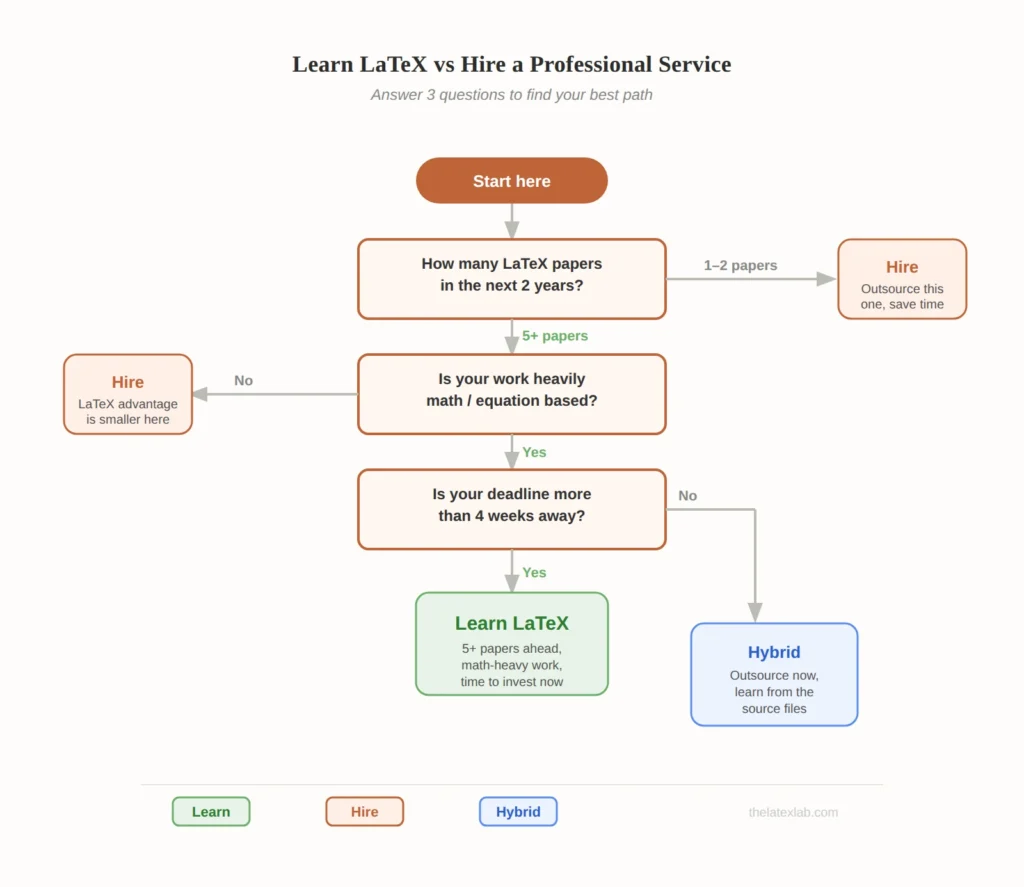 To make this concrete, here is a simple framework. Answer these three questions:
1. How many papers will you format in LaTeX over the next two years? If the answer is one or two, outsource. If it is five or more, learn. If it is three or four, consider the hybrid approach.
2. Does your work involve heavy math notation? If yes, learning LaTeX gives you a permanent advantage for equation editing regardless of how many papers you write. If your papers are primarily text with occasional simple equations, the formatting advantage is smaller.
3. Is your deadline more than four weeks away? If yes, you have time to learn if you want to. If no, outsource this one and learn for the next one.
If you answered “outsource” to two or more of those questions, hiring a professional service is the pragmatic choice right now. You can always learn later, and you will learn faster with professionally formatted source files as your reference material.
Ready to get your paper formatted?
Whether you are outsourcing for the first time or using the hybrid approach, we deliver submission-ready LaTeX with source files you can learn from. IEEE, Elsevier, Springer, ACM, and 200+ other templates. From $149.
Frequently asked questions
For a first-time user formatting a real research paper (not a tutorial exercise), expect 30-52 hours spread over three to four weeks. This includes learning the basics, formatting equations and tables, setting up the bibliography, and debugging compilation errors. By your third or fourth paper, formatting time drops to 5-8 hours per paper.
Professional LaTeX formatting services typically charge $149-449 for a journal paper, depending on length, number of equations, tables, and references. Thesis formatting ranges from $599-1,999. Freelancers on platforms like Upwork or Fiverr may charge less, but quality varies significantly. Always confirm that the service delivers editable .tex source files, not just a PDF.
Overleaf makes LaTeX more accessible by removing the installation and compilation setup, but you still need to learn LaTeX syntax. It does not eliminate the learning curve for equations, tables, bibliography management, or template configuration. What Overleaf does well is provide real-time preview and access to hundreds of journal templates, which shortens the template setup phase.
A reliable service should always deliver the complete .tex source file, .bib bibliography file, any custom style files, and figures in the correct format. If a service only provides a compiled PDF, you will not be able to make edits or submit to journals that require source files. Ask about this before placing an order.
In most cases, no. The time investment for a single paper (30-50 hours for a first-timer) far exceeds the cost of professional formatting ($149-449). The exception is if your paper is very math-heavy and you expect to work with equations regularly in the future, even outside of journal submissions. If this is truly a one-time need, outsourcing is the more efficient choice.
The hybrid approach means outsourcing your first paper to a professional service, then using the .tex source files you receive as a learning reference. You study how your equations, tables, and bibliography were formatted in a real document from your field. For your second paper, you format it yourself using the first as a template, and by the third paper you are working independently. This skips the most frustrating parts of learning LaTeX – installation, template setup, and bibliography configuration – and gets you straight to productive learning.
