Guide to make Chemistry Accessible in LaTeX like Formula, Notation, Reactions, etc. Chemistry is the hardest case in document accessibility, and the reason is that “chemistry” is really two different problems wearing one name. Chemical formulas and reactions are linear and behave like math, so they can be made accessible. Chemical structures are 2D drawings, and those mostly cannot be made screen-reader-navigable in a PDF, at least not automatically. Most guides lump them together and leave you stuck. This separates them, shows what actually works for each in 2026, and is honest about where the answer is an accommodation rather than a tag.
Chemistry Linear notation and structures accessibility problems
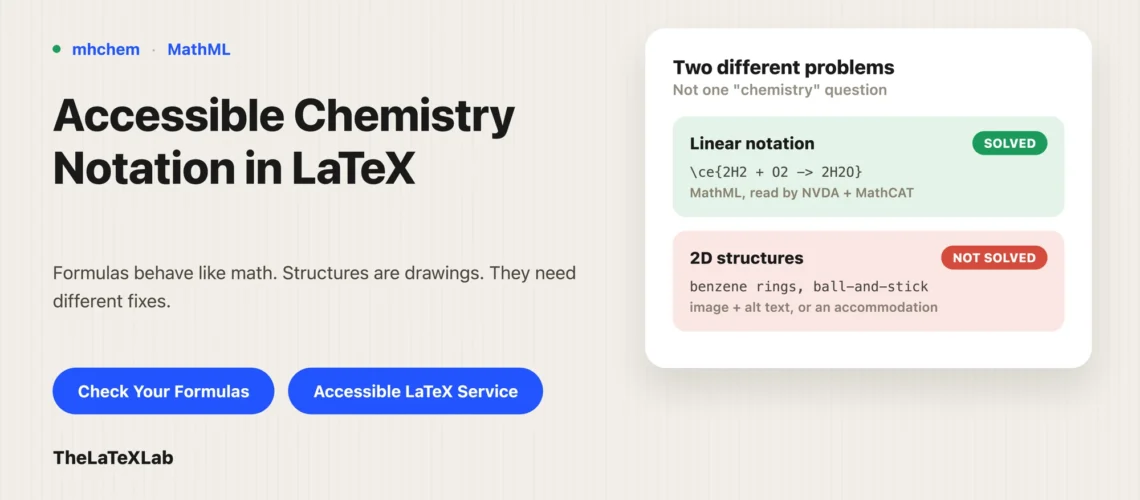
Two kinds of “chemistry” show up in a document, and they need completely different handling:
- Linear notation: formulas like H2SO4, reactions like 2H2 + O2 gives 2H2O, nuclear decay. These read left to right, one symbol after another. They behave like math.
- Structures: skeletal diagrams, benzene rings, ball-and-stick models, protein structures. These are spatial 2D drawings, not sequences.
Linear notation is close to a solved problem. Structures are not. Treating them as one question is why people go in circles: “how do I get a screen reader to read this formula” and “how do I describe a 15-panel structure figure” have different answers, and only the first one has a clean one.
Chemical formulas and equations can be MathML
A chemical formula or reaction encoded as MathML in a tagged PDF can be read by a screen reader. NVDA with the MathCAT add-on has chemistry support built in: it detects chemical formulas from element symbols, subscripts, and common patterns, and reads them with chemistry-aware speech instead of spelling out symbols one by one. So a formula is voiced as chemistry, not as an ambiguous string of letters and numbers.
This is the same path as math generally: MathML inside a PDF 2.0 file, read by NVDA plus MathCAT. Whether a specific reader actually voices it depends on their screen reader and PDF viewer, the same caveats that apply to any math, covered in how to make math accessible in PDFs. The short version: get the chemistry into MathML and the linear-notation problem is largely handled.
Writing chemistry in LaTeX with mhchem for Accessibility
In LaTeX the standard tool is the mhchem package, which gives you \ce:
\ce{H2SO4}
\ce{2H2 + O2 -> 2H2O}
mhchem typesets chemistry properly through math mode. Under the modern tagging workflow (a \DocumentMetadata block with tagging-setup={math/setup=mathml-SE}, compiled with LuaLaTeX on TeX Live 2025 or later), that output is tagged as MathML like any other math, so your formulas carry real structure into the accessible PDF rather than landing as flat text or an image. Confirm they did with our LaTeX math accessibility checker, which tells you whether each formula carries MathML. Then verify by listening, because chemistry reading is good but not flawless, and a quick pass with a screen reader catches the cases where it is not.
Reach out to us for chemistry accessibility in your document
We get your formulas and reactions into tagged MathML that a screen reader can read, write real descriptions for the structures that have to stay as images, and tell you honestly which ones need an accommodation instead. Built for the STEM documents where generic remediation gives up.
Structure diagrams in Chemistry cannot be tagged like formulas
A 2D structure, whether drawn with chemfig or dropped in as an image exported from a tool like ChemDraw, is a picture. There is no MathML for a skeletal structure that a screen reader can walk through, and no tagging setting turns a benzene ring diagram into something a reader can explore. This is the genuinely unsolved part of accessible chemistry, and it is worth saying plainly rather than pretending a checkbox fixes it.
So a structure in a PDF is an image, and images get alt text through the usual alt text mechanism in LaTeX. The catch is that a short alt string cannot convey a complex structure in a way a reader can reason about. For a simple molecule that is fine. For a large or intricate one, “impossible to describe well” is a fair assessment, not a failure on your part.
SMILES and InChI as text alternatives For Chemistry Formula
SMILES is a plain-text line notation for a structure: CCO is ethanol, c1ccccc1 is benzene. InChI is a longer, unambiguous identifier for the same purpose. Both are machine-readable and can be read or copied as text, which makes them useful in two honest ways:
- As an input accommodation. Letting a blind student submit a structure as SMILES instead of drawing it with a mouse-driven editor removes a real barrier. This is often the single most useful thing you can do.
- As a companion in the document. Include the SMILES or InChI, and the IUPAC name, alongside a structure so a reader has a text handle on it.
One caveat that catches people: a raw SMILES string read aloud is not meaningful chemistry to most listeners. It is data, not a description. Provide it as a machine-readable companion, paired with the name and a description, not as “the accessible version” on its own.
What a good Chemistry structure description includes
When you have to keep a structure as an image, the description should carry the essential chemistry, not the phrase “chemical structure.” Say what the atoms are and how they connect, at the level the reader needs. “Ethanol: a two-carbon chain with a hydroxyl group on the end carbon” is useful. A ball-and-stick model of water is “an oxygen atom bonded to two hydrogens in a bent shape.” Include the name, and the SMILES or InChI where it helps.
How much detail depends on what the reader has to do with it. Identifying a molecule needs less than analyzing a reaction mechanism. This is judgment, not a fixed template, and it is where a chemist’s eye matters more than any tool.
When to fall back to the accommodation process
Some content is irreducibly visual. A large protein structure, a multi-panel figure, a mechanism that only makes sense drawn out. No description or line notation makes those fully navigable, and forcing a bad one helps no one. For those, the right route is meaningful access through the accommodation process: work with your disability services office and provide an equivalent, whether that is a described version, a tactile or 3D model, a data file, or direct support. This is the meaningful-access idea behind ADA Title II for course materials, not a tagging trick.
We frequently see people burn weeks trying to make an irreducibly visual figure screen-reader-navigable when the honest, compliant answer was an accommodation from the start. Knowing which case you are in saves the most time.
Checking your chemistry notation
Two passes. First, confirm your \ce formulas actually carry MathML by running the source through our math accessibility checker, then listen to a few with NVDA and MathCAT (with the chemistry preference on) to hear how they read. Second, go through every structure and confirm it has a real description, and where useful a SMILES or InChI and a name, and flag the ones that genuinely need an accommodation. That second pass is manual and needs a chemist’s judgment, which is exactly why it does not reduce to a checker score.