The European Accessibility Act put publishers on a deadline that has already passed for new content. Since 28 June 2025, e-books and digital publications sold to readers in the EU have to be accessible, and that reaches academic and journal publishers whether or not they are based in the EU. If your titles or articles are sold or distributed to EU readers, this applies to you. Here is what the EAA requires, the two dates that matter, the standard, and the part that trips up publishers who assume a tagged PDF is enough.
Who the EAA (European Accessibility Act) applies to
The EAA (Directive (EU) 2019/882) covers products and services sold to consumers in the EU, and it names e-books and e-book services specifically. Scholarly, journal, and academic publishers distributing to EU readers are in scope, and several large publishers have already issued public statements about it.
The publisher’s own location does not matter. If you sell or distribute into the EU market, you are covered, even from outside the EU. The main carve-out is for micro-enterprises: providers with fewer than 10 employees and under 2 million euro annual turnover are generally exempt, and there is a separate “disproportionate burden” clause. Most university presses and established journals do not qualify as micro-enterprises, so for them the exemption is not a way out.
The two deadlines: 2025 and 2030
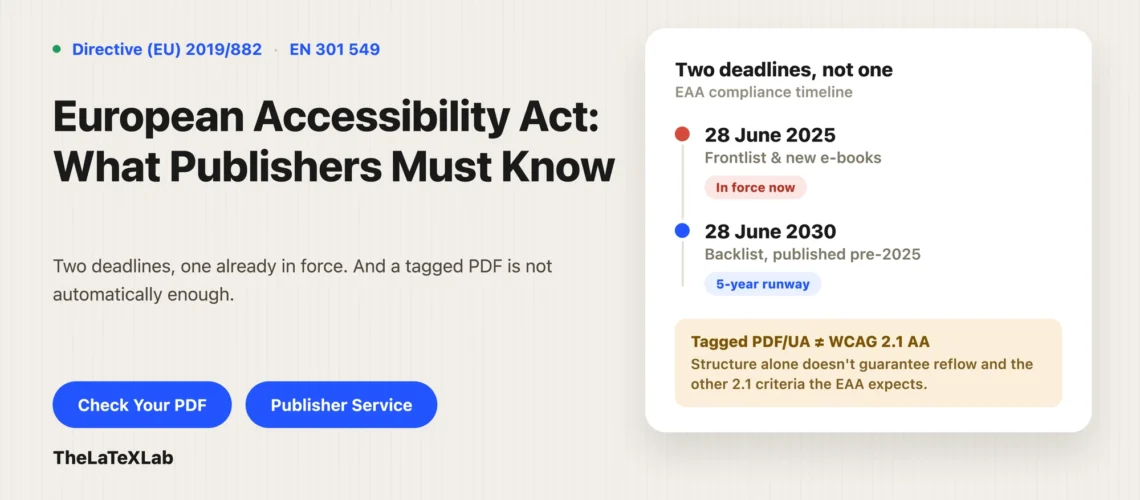
There are two dates, and they treat new and old content differently:
- 28 June 2025 for new, frontlist content and newly published e-books. This is in force now. Non-compliance can mean penalties, fines, or removal of a product from the EU market.
- 28 June 2030 for backlist e-books published before June 2025. The existing catalogue gets a five-year runway; new content does not.
So the frontlist is the immediate problem. Anything you publish now has to be accessible on release.
The standard you have to meet for EAA
The technical bar is set by EN 301 549, the harmonized European standard that gives a presumption of conformity. EN 301 549 incorporates WCAG 2.1 Level AA, and it extends beyond web pages to cover non-web documents like PDFs. Meet WCAG 2.1 AA and you are aligned with what the EAA expects technically.
For e-books specifically, the expected target is EPUB in the EPUB Accessibility 1.1 profile plus WCAG 2.1 AA, including the accessibility metadata that lets a store and a reader know what the file supports.
Get journal LaTeX classes Updated to meet EAA Accessibility Requirements
We update your class or template once so every article compiles to a tagged, WCAG 2.1 AA PDF with real MathML math, instead of remediating each PDF by hand. Built for the STEM journals where generic remediation falls down.
A tagged PDF is not automatically enough
This is the part that catches publishers. A tagged, PDF/UA-conformant PDF is necessary, but it is not automatically WCAG 2.1 AA. PDF/UA covers structure and tagging, but PDF/UA-1 predates WCAG 2.1, so it does not by itself guarantee the newer 2.1 criteria, most notably 1.4.10 Reflow (content reflowing to a single column on a small screen without loss). A file can be cleanly PDF/UA and still miss the EAA’s bar.
The takeaway is not that PDF/UA does not matter. It does, and tagging is the structural foundation. But tagging alone is not the finish line. You still have to meet the WCAG 2.1 AA criteria that a tagging check does not score. What PDF/UA is, and how it differs from WCAG, is covered in what PDF/UA actually is.
You usually need one accessible format, not every format
The requirement is that the content is available to a reader in an accessible form, not that every format you happen to ship is perfect. In practice, providing at least one fully accessible version of a work, whether that is accessible HTML full text, an accessible EPUB, or a properly tagged and WCAG-checked PDF, is what matters. This is why many scholarly publishers lead with accessible HTML full text and treat the PDF as a secondary format. Confirm the specifics for your catalogue with your own accessibility and legal teams, but the practical point stands: pick a format you can make genuinely accessible and get it right, rather than half-fixing all of them.
What this means for a LaTeX journal workflow
For STEM journals produced from LaTeX, an accessible output has to carry real document structure and real math, which means equations encoded as MathML, not pasted in as images. Doing that per article, after the fact, does not scale across a journal.
The workflow that does scale is to fix the journal’s LaTeX class or template once, so that every article compiles to a tagged, WCAG-checked PDF (and accessible HTML where you offer it) without per-article remediation. That is the difference between a compliance cost that recurs on every submission and a one-time change to the class. This is the work behind our LaTeX template service for publishers.
How the EAA compares to US rules
The EAA is the EU counterpart to the accessibility pressure US publishers already know. The difference is how it reaches you: the EAA binds you directly through the EU market, where in the US the pressure is indirect, through public universities that must buy accessible content under ADA Title II and through federal procurement under Section 508. The technical target is close to the same on both sides, WCAG 2.1 AA under the EAA and WCAG 2.0 or 2.1 AA in the US, so building to WCAG 2.1 AA generally satisfies both at once. If you sell internationally, you do not need a separate standard for each market.
How to check where a PDF stands
Start by confirming the file is actually tagged. Run it through our PDF/UA checker to see whether the structure is there. Then check the WCAG 2.1 AA criteria that a tagging check does not score, which is the human half: contrast, reflow, meaningful alt text, and reading order. For a single article this is a manual pass. For a whole journal, checking every PDF one at a time is the slow way; fixing the class so the output is right from the start is the fast one.