Professor José Carlos Cavalcanti sent us a 45-page economics paper written in Word (docx) and needed it as a LaTeX file on a Springer journal template, on a rush deadline. The document held 258 equations and 9 tables. We converted it, then checked it against the journal’s requirements and sent him five questions before finalising. He answered the same day and we delivered submission ready LaTeX within 24 hours of deadline.
Project at a glance
| Client | Prof. José Carlos Cavalcanti |
| Location | Brazil |
| Field | Economics |
| Job | Word to LaTeX conversion, journal formatting |
| Source file | 45-page .docx, 258 equations, 9 tables, no figures |
| Target | Springer economics journal, sn-jnl template (v3.1) |
| Delivered | .tex source and compiled PDF, tested in Overleaf |
| Author input | One round, 5 questions, answered same day |
| Project Received | Files received Sat 11 April 2026 |
| Project Delivered | delivered Sun 12 April 2026 |
He has agreed to let us publish this write-up, including the messages. The paper itself stays private, so this covers the shape of the document and the work done to it, not its content.
What the client asked for
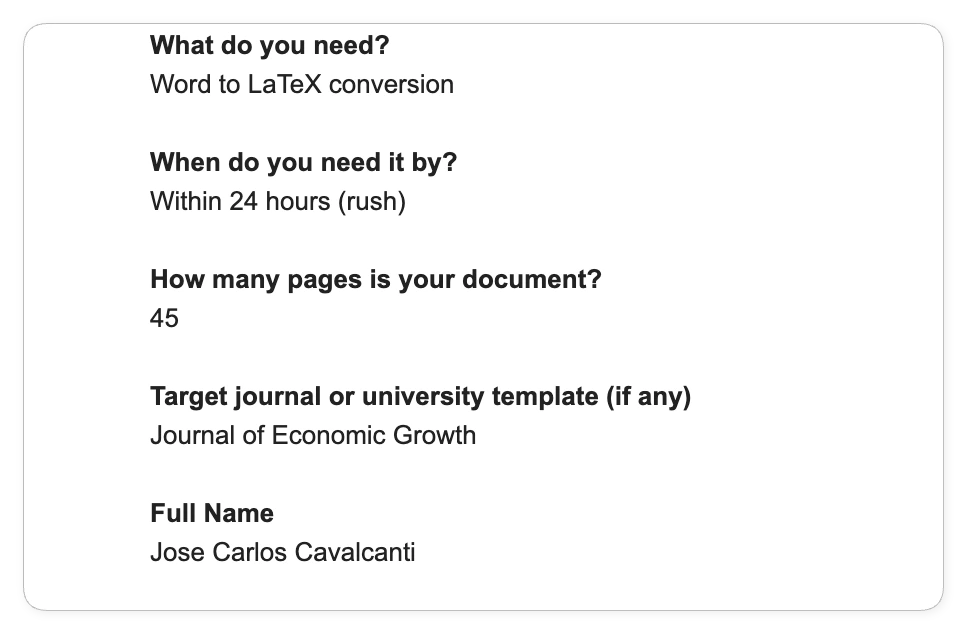
- Word to LaTeX conversion
- 45 pages
- Rush, within 24 hours
- Target: a Springer economics journal template
The Springer part is the constraint that shapes the rest of the job. Springer’s sn-jnl class has its own citation styles, its own front-matter commands and its own rules about what a submitted manuscript can contain. We have written up how that class works in our Springer sn-jnl template guide.
First contact and approval
We moved to WhatsApp and sent the process and Quote.
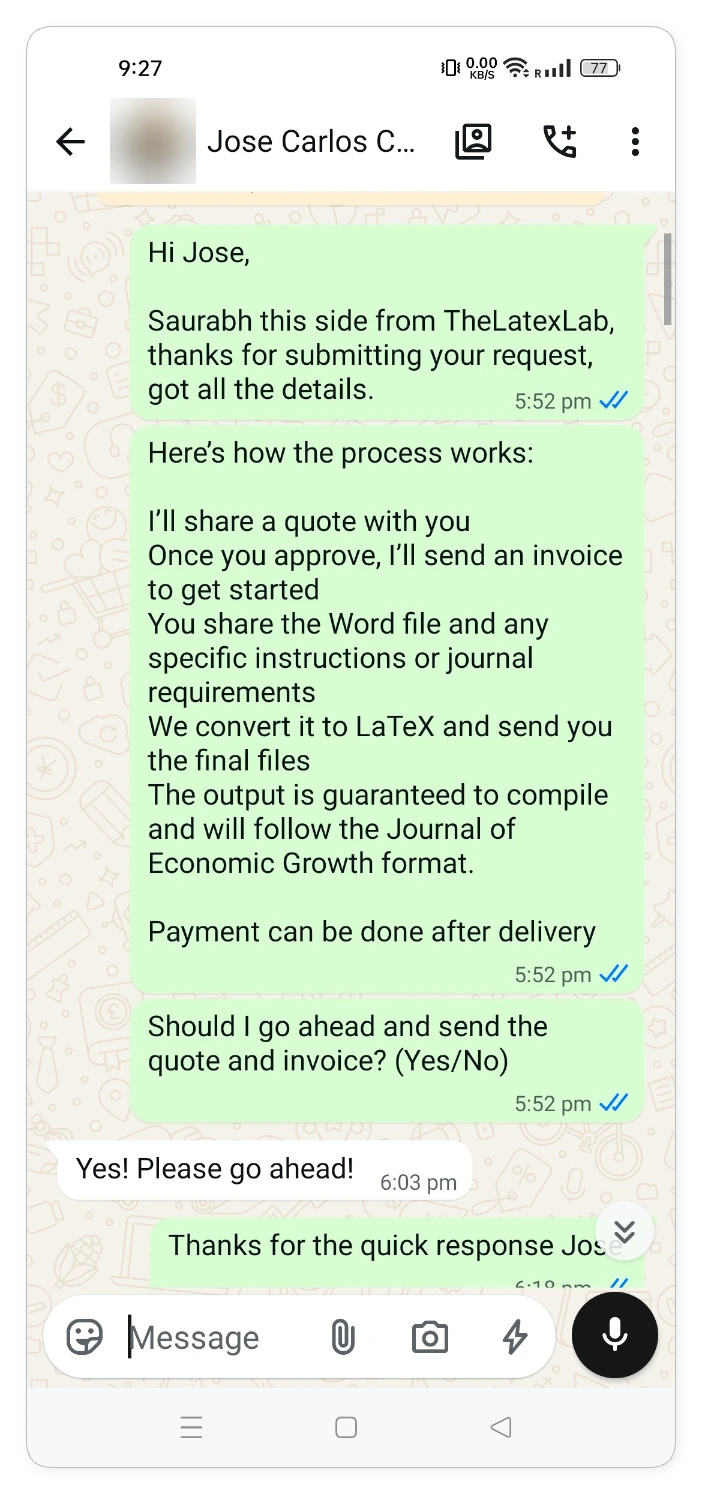
The message says the output is guaranteed to compile and to follow the journal format, and that payment happens after delivery. Both are standard for us. First-time clients are usually more worried about the second one.
He replied at 6:03 pm: “Yes! Please go ahead!”
Files we received
The Word document arrived at 6:26 pm. We then asked for the journal’s own template package.
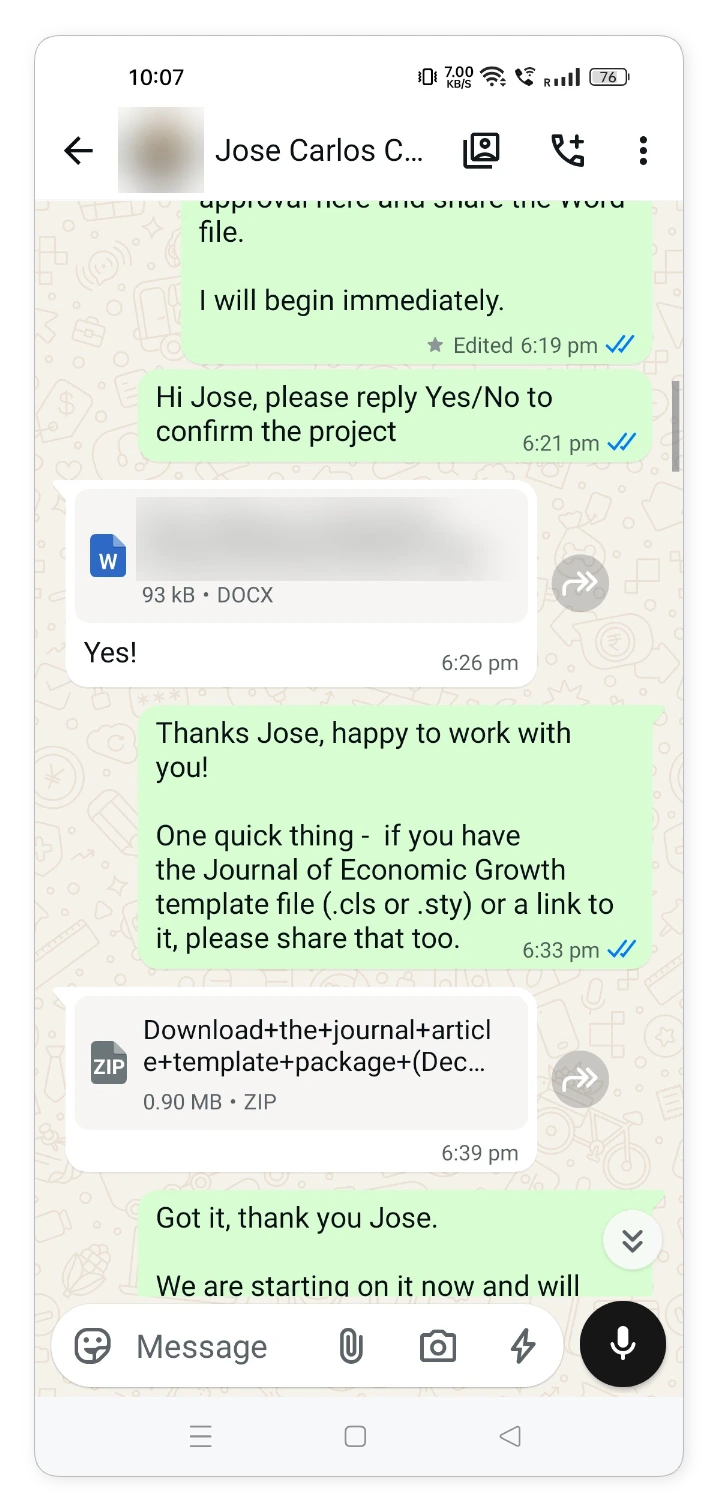
He had it and sent it at 6:39 pm. This is worth asking for every time. Working from the publisher’s actual .cls file means the output is the real template instead of something that looks like it, and it removes a category of problems that otherwise show up at submission. The current package is on Springer Nature’s LaTeX author support page if a client does not have it.
What was in the Word document
We check this before starting, because page count alone tells you very little about how long a conversion takes.
| Element | Count | Notes |
|---|---|---|
| Equations | 258 | 127 display, rest inline. Word equation objects, not images. |
| Tables | 9 | Rebuilt with booktabs to match journal style |
| Sections | 10 | Plus 36 subsections |
| Propositions | 12 | Needed real theorem environments, not bold text |
| Definitions | 2 | Same |
| Figures | 0 | Unusual. All the difficulty was in the maths. |
258 equations is the number that sets the timeline. Everything else on that list is routine.
One other thing we noticed on opening it. The internal Word styles were MdHeading1, MdParagraph and MdListItem, which means the document was generated from Markdown rather than typed in Word, plus one list style in Portuguese from the author’s own copy of Word. Checking this early tells you which formatting in the file is reliable and which needs rebuilding.
Questions we had to ask before it was submission-ready
The conversion was the faster half. The slower half was reading the manuscript against what the journal requires.
We sent a pre-submission review the next morning: a written document listing each open item, what we had done about it, and what we needed back. Five items, each with the same three-part structure – what the journal requires, what we are currently using, what the author needs to confirm or correct.
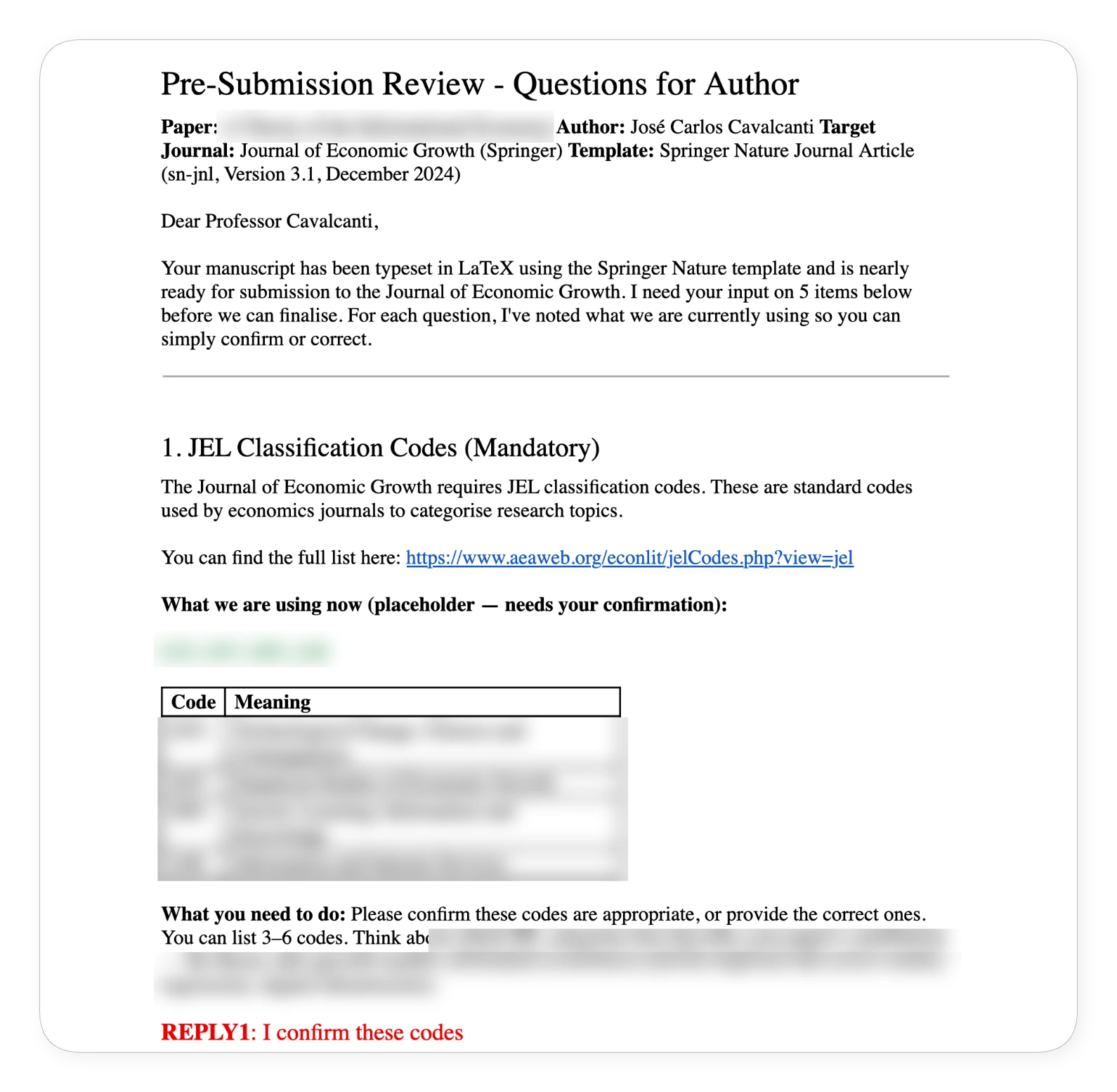
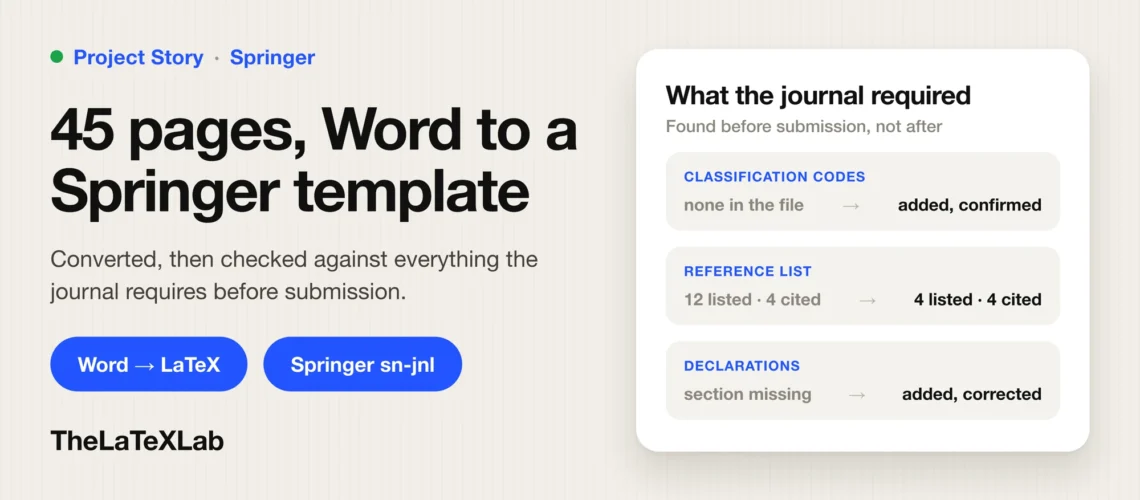
- Classification codes. Required by the journal. The manuscript had none. We proposed a set with an explanation of each and asked him to confirm or replace them.
- Citation style. Confirming the author-year format the journal uses, and which Springer bibliography style produces it.
- Uncited references. 12 entries in the reference list, 4 cited in the text. Springer requires every listed reference to be cited. We listed each uncited one with a suggested location and asked him to place it or drop it. He chose to remove all eight.
- Declarations. The journal requires a declarations section covering funding, competing interests, data availability and author contribution. The Word file had none. We drafted it and asked him to correct each line.
- Acknowledgements. Placement and wording for a journal rather than a draft.
None of that is typesetting, and none of it is optional. Eight uncited references would have come back from the editor on their own.
He answered the same day and the answers went into the final file.
What we delivered
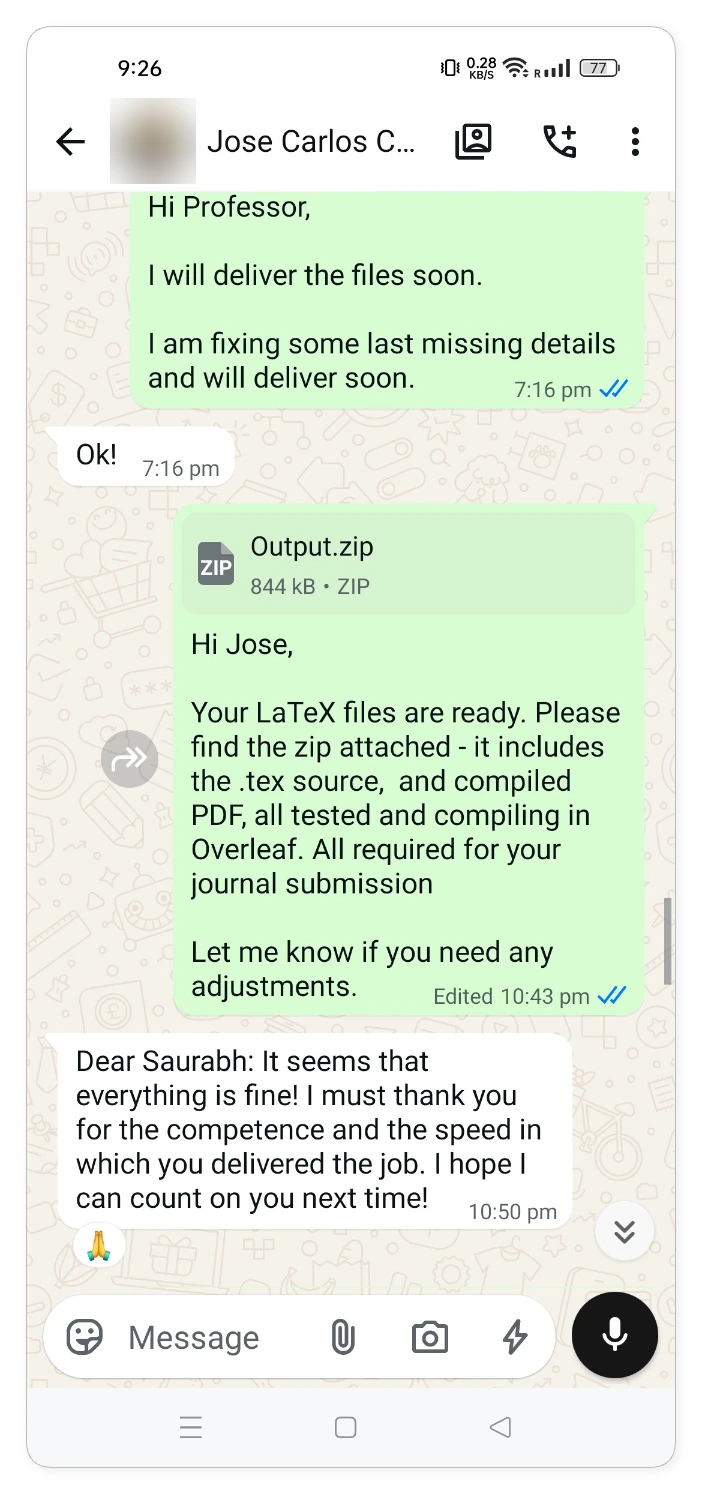
Sent at 10:43 pm: the .tex source built on the publisher’s class file, and the compiled PDF. Everything was tested in Overleaf so he could open, edit and recompile it without installing anything locally.
Delivered files
| Word file received | LaTeX file delivered | |
|---|---|---|
| Format | .docx | .tex on Springer sn-jnl class, plus PDF |
| Length | 45 pages | 35 typeset pages |
| Equations | 258 Word equation objects | 123 numbered display equations, 176 inline math spans |
| Tables | 9 Word tables | 9 booktabs tables |
| Propositions and definitions | Bold text | 14 real theorem environments |
| Reference list | 12 entries, 4 cited | 4 entries, 4 cited |
| Classification codes | None | Added, author-confirmed |
| Declarations section | Absent | Present, author-corrected |
Timeline
| Time | Event |
|---|---|
| Sat 5:52 pm | First message from us |
| Sat 6:03 pm | Client approves |
| Sat 6:19 pm | Quote and invoice sent |
| Sat 6:26 pm | Word file received |
| Sat 6:39 pm | Journal template received |
| Sun 8:26 am | Pre-submission review sent to client |
| Sun, same day | Client’s answers received |
| Sun 10:43 pm | Files delivered |
What the client said
His reply came at 10:50 pm, seven minutes after delivery.
Dear Saurabh: It seems that everything is fine! I must thank you for the competence and the speed in which you delivered the job. I hope I can count on you next time!
— Prof. José Carlos Cavalcanti, Brazil
Get Your Word manuscript converted to LaTeX for journal submissionSend the document and the template. You get a flat-fee quote, a submission ready LaTeX files, and a list of what the journal needs before you submit.
Who we usually do this for
This project is typical of the work, so it is worth being specific about the client.
- Academic author with a finished manuscript in Word
- Maths-heavy paper
- Manuscript with Equations, Tables, chemistry, Tikz, Bibliography, figures,
- Needs Professional Word to LaTeX Conversion for Journal Submission
Most of our clients fit that description: researchers, professors and PhD candidates converting Word manuscripts to LaTeX for journal submission, usually against a Springer, IEEE, Elsevier or ACM template, often with equation-dense text and a bibliography that needs rebuilding as proper BibTeX entries. Thesis and dissertation authors come to us for the same reasons on a longer timeline.
You can read our Tutorial guides on LaTeX, see how to convert Word to LaTeX and the Springer submission errors that catch people out.